...but am extremely glad I did.
Sunday, April 13, 2008

Saturday, April 12, 2008
Rhymes with Katana
As a rap lyricist I lack breadth but not depth. Continuing a series:
drunk on bourbon whiskey,
it's disturbin and risky
how you try and dis me
you really don't wanna
i'm quick like katana, slick like satana
aka satan it's fate son here's a lesson:
you try and teach me
you'll never reach me
blind swordsman: Zatoichi
drunk on bourbon whiskey,
it's disturbin and risky
how you try and dis me
you really don't wanna
i'm quick like katana, slick like satana
aka satan it's fate son here's a lesson:
you try and teach me
you'll never reach me
blind swordsman: Zatoichi
Thursday, April 10, 2008
In a Metal Mood
Eminent comics writer and blogger Kevin Church has posted a list of 10 songs he'd pay good money to hear performed in a black metal style. As noted in the comments to his post, Celtic Frost has done Mexican Radio. It's actually a very reverent cover right down to the funny voices. But I don't know if anyone would have anticipated Dead Raven Choir's demolition of Leonard Cohen. I sure didn't.
A black metal cover of "American Pie" is the one I'm waiting to hear. Maybe Darkthrone would do it. Those guys are pretty funny.
MP3: Celtic Frost,Mexican Radio
MP3: Dead Raven Choir,First We Take Manhattan (check your volume; this is blown-out and loud as hell)
See also:
Gavin Spearhead's Coversongs List. Exhaustive and exhausting; howsabout a search feature, Gavin?
Turnabout is fair play for Pat Boone
A black metal cover of "American Pie" is the one I'm waiting to hear. Maybe Darkthrone would do it. Those guys are pretty funny.
MP3: Celtic Frost,
MP3: Dead Raven Choir,
See also:
Gavin Spearhead's Coversongs List. Exhaustive and exhausting; howsabout a search feature, Gavin?
Turnabout is fair play for Pat Boone
Wednesday, April 9, 2008
A few hundred words on 300
I saw 300 on DVD the other night. I'm not particularly a fan of the book, nor much else of Frank Miller for that matter. I certainly wasn't hoping for the movie to be a timeless classic, or even a decent historical actioner. Exactly the opposite in fact: it slots neatly into my Netflix queue between Hawk the Slayer and, oh sweet reason, Ator, the Fighting Eagle. I expected violent, I expected dumb, I expected sword-hacking, shield-bashing and streams of gore. And sure, 300's got all that. With sandals and a fringe on top.
300 is at its heart a story about valiant warriors fighting to win glory or die with honor against deadly odds. I'm a complete sap for scenes of heroism and sacrifice. Everything from Boromir redeeming himself at Parth Galen down to a damn show on Animal Planet about a chihuahua saving a little girl from a rattlesnake will choke me right up. They're tears, but they're brave tears, don't dog me. But 300 left me dry-eyed and searching for the Visine.
The movie goes to absurd lengths to separate the good Spartans not only from the decadent Persians and their faaabulous King, but from the "boy-lovers of Athens" and even the brave volunteers who fight with the Spartans. The Spartans are tumescent; all others limp. The Spartans are statuesque, sculpted, proud-blooded and erect; their foes not merely dark-skinned but grotesque, bestial, lamed. Among the Persian forces I noted orcs, Frankenstein, and a Cenobite apparently wandered off the set of a Hellraiser sequel. And between all the fighting is a lot of bellowing and brow-beating about the free men of Sparta defending freedom which, we daren't forget, isn't free.
But what of the freedom of Sparta? What of this city of free men and strong women? That's the question that movie and book alike fail to answer. The city is barely sketched, a few columns and fountains, plain stone walls. There are no scenes of everyday Spartan life, no merchants or musicians. The chief freedom afforded Spartan boys, we're shown, is the freedom to study the arts of battle and war:
See also: Dave White takes this much less seriously.
300 is at its heart a story about valiant warriors fighting to win glory or die with honor against deadly odds. I'm a complete sap for scenes of heroism and sacrifice. Everything from Boromir redeeming himself at Parth Galen down to a damn show on Animal Planet about a chihuahua saving a little girl from a rattlesnake will choke me right up. They're tears, but they're brave tears, don't dog me. But 300 left me dry-eyed and searching for the Visine.
The movie goes to absurd lengths to separate the good Spartans not only from the decadent Persians and their faaabulous King, but from the "boy-lovers of Athens" and even the brave volunteers who fight with the Spartans. The Spartans are tumescent; all others limp. The Spartans are statuesque, sculpted, proud-blooded and erect; their foes not merely dark-skinned but grotesque, bestial, lamed. Among the Persian forces I noted orcs, Frankenstein, and a Cenobite apparently wandered off the set of a Hellraiser sequel. And between all the fighting is a lot of bellowing and brow-beating about the free men of Sparta defending freedom which, we daren't forget, isn't free.


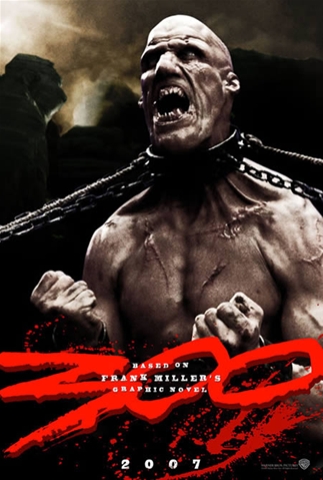
But what of the freedom of Sparta? What of this city of free men and strong women? That's the question that movie and book alike fail to answer. The city is barely sketched, a few columns and fountains, plain stone walls. There are no scenes of everyday Spartan life, no merchants or musicians. The chief freedom afforded Spartan boys, we're shown, is the freedom to study the arts of battle and war:
"At age 7, as is customary in Sparta, [a] boy [is] taken from his mother and plunged into a world of violence, manufactured by 300 years of Spartan warrior society to create the finest soldiers the world has ever known. The agoge, as it's called, forces the boy to fight, starves him, forces him to steal... and if necessary, to kill."Slaves unnumbered are cut down like grass, and Spartan blood is the price of each inch of the Persian advance, for this? A city whose only arts are the phalanx, the whetstone and, on the film's evidence, the ab crunch? The place hardly seems worth saving. I was unmoved, and not much entertained.
See also: Dave White takes this much less seriously.
Saturday, April 5, 2008
Dino Punks Are Go!
 Yesterday browsing the new book cart at my local library I came across DINOSAURS: The Most Complete, Up-to-Date Encyclopedia for Dinosaur Lovers of All Ages by Dr Thomas R Holtz, Jr. I never could resist a dinosaur book, and this looks like a good one. What really sets it apart though, are the illustrations by Luis V Rey. They are far. out.
I wrote a whole paragraph here about recent fossil discoveries of feathered dinosaurs, and comparisons of nasal openings in the skulls of dinosaurs and living animals, and the display hypothesis. I did a websearch on protofeathers. It was turning into a book report.
But what I really want to talk about it how all of the above has inspired Mr Rey to cut loose. The latest paleontological hypothesis + wild imagination = Dino Punks! Zebra stripes, flashy crests, brilliant cloaks and ruffs of feathers! Iridescent scales, wicked spines, drooping fleshy wattles! It's wondrous and joyful. You can find more at the artist's website, here.

MP3: Mittens on Strings,
Friday, April 4, 2008
On the Beach and At the Table
 A post the other day on Dr Rotwang's I Waste The Buddha With My Crossbow, about Rush, a kitchen table and his "personal nerd nirvana" has me thinking all the way back to 1984, and one of my own gaming epiphanies.
Summer vacation, and I'd talked my folks into buying me the 2nd Edition of Gamma World on a day trip to Saugatuck--back in the day you could get your sci-fi apocalypse down at the five-and-dime. For what remained of our two weeks away, I spent most of each afternoon in a small bedroom facing Lake Michigan, windows on three sides, with lake breezes and afternoon sun lazing through the curtains, reading through the rulebook, rolling up characters, and daydreaming about the badass mutants on the cover. I stretched out on the floor and listened to the radio hoping for my favorite songs of the time--Billy Idol, "Eyes Without a Face" or Prince, or Wang Chung, or Eurythmics.
Those notes are long gone now, of course. Fool for nostalgia that I am that makes me a little sad. But here's the thing: I've got a dining room table. I've got plenty of dice and lots of room to spread out. And I've got stacks of music. Perfect moments are fleeting. In this life you're on your own.
MP3: Prince,
See also: Top Hits of 1984; Michigan in Pictures: South Haven
Thursday, April 3, 2008
Conan, Cugel, and others
At Grognardia, James Maliszewski's begun a project tracing the roots of Dungeons & Dragons, and has started it off writing about the game's roots in pulp fantasy -- Howard, Lovecraft, Leiber, Vance and others whose influence Gary Gygax made clear in a reading list in the AD&D Dungeon Master's Guide.
One of Mr Maliszewski's posts quotes Robert E Howard's introduction of Conan, a single sentence that captures the whole epic and bloody swath of the Barbarian's life and doings:
Here's the introduction of yet another rogue from Gary's reading list, Cugel the Clever, from Jack Vance's The Eyes of the Overworld.
How he fits into the character archetypes of early D&D is less obvious than Conan, Fafhrd and the Mouser. Cugel more often ekes by on his wits than by sorcery or sword. However I do think there's something of him in many of Gygax's adventure modules -- with his many mishaps and missed chances, narrow escapes and reversals of fate, and with his implacable overconfidence despite all setbacks, Cugel is the very model of the hapless PC set loose amidst the traps and tricks of a Gygaxian dungeon.
One of Mr Maliszewski's posts quotes Robert E Howard's introduction of Conan, a single sentence that captures the whole epic and bloody swath of the Barbarian's life and doings:
Hither came Conan, the Cimmerian, black-haired, sullen-eyed, sword in hand, a thief, a reaver, a slayer, with gigantic melancholies and gigantic mirth, to tread the jeweled thrones of the Earth under his sandalled feet.In reply one of the commenters quotes Leiber's introduction of Fafhrd and the Gray Mouser:
"I see we're expected," the small man said, continuing to stroll toward the large open gate in the long, high, ancient wall. As if by chance, his hand brushed the hilt of his long, slim rapier."It's interesting to compare the two passages. Howard's is deliberately grand and mythic, an epigraph taken from a chronicle of mighty deeds. In his first story Conan is already King of Aquilonia; his long road to the throne comes later, tale by tale. By contrast Leiber is more matter of fact, giving us Fafhrd and the Mouser in media res and at street level, two rogues run afoul of the Thieves' Guild wittingly walking into an ambush.
"At over a bowshot distance how can you-" the big man began. "I get it. Bashabeck's orange headcloth. Stands out like a whore in church. And where Bashabeck is, his bullies are. You should have kept your dues to the Thieves Guild paid up.""It's not so much the dues," the small man said. "It slipped my mind to split with them after the last job, when I lifted those eight diamonds from the Spider God's temple."
The big man sucked his tongue in disapproval. "I sometimes wonder why I associate with a faithless rogue like you."
The small man shrugged. "I was in a hurry. The Spider God was after me..."
Here's the introduction of yet another rogue from Gary's reading list, Cugel the Clever, from Jack Vance's The Eyes of the Overworld.
Cugel was a man of many capabilities, with a disposition at once flexible and pertinacious. He was long of leg, deft of hand, light of finger, soft of tongue. His hair was the blackest of black fur, growing low down on his forehead, coving sharply back above his eyebrows. His darting eye, long inquisitive nose and droll mouth gave his lean and bony face an expression of vivacity, candor, and affability. He had known many vicissitudes, gaining therefrom a suppleness, a fine discretion, a mastery of both bravado and stealth. Coming into the possesion of an ancient lead coffin--after discarding the contents--he had formed a number of lead lozenges. These, stamped with appropriate seals and runes, he offered for sale at the Azenomei Fair.It's a far cry from Howard's heroic tone, and while Leiber's heroes have vicissitudes of their own, Cugel's tale is downright picaresque. Accordingly Vance introduces him in a way that is both inflating and mocking--Cugel is deft and clever, but also rat-like with his furry widow's peak and twitching nose, and we meet him fresh from a grave-robbing, selling fake magic tokens. His expression is of "vivacity, candor, and affability," but he proves instead to be brisk, guileful, and pugnacious.
How he fits into the character archetypes of early D&D is less obvious than Conan, Fafhrd and the Mouser. Cugel more often ekes by on his wits than by sorcery or sword. However I do think there's something of him in many of Gygax's adventure modules -- with his many mishaps and missed chances, narrow escapes and reversals of fate, and with his implacable overconfidence despite all setbacks, Cugel is the very model of the hapless PC set loose amidst the traps and tricks of a Gygaxian dungeon.
Subscribe to:
Posts (Atom)